





Continuation into other Riemann sheets#
The scattering amplitude can be analytically continued into the complex plane from the observable lineshape on the real axis. Its analytic structure is inherited from the phase space factor, where each two-body threshold results in a branch point. From this branch point onwards, the branch cut continues to \(+\infty\) along the real axis, giving rise to two solutions called Riemann sheets. Each additional two-body threshold branch point gives rise to another pair of Riemann sheets. The sheet continued from the physical amplitude is called the physical sheet. Continuing this sheet over the branch cut leads us to the unphysical Riemann sheets, which contains the poles that characterize a hadronic state. This notebook aims to calculate the unphysical Riemann sheets for \(L = 1\) using the Chew–Mandelstam dispersion integral.
\(T\) matrix definition#
According to PDG 2025, §50. Resonances, Eq. (50.41), the scattering amplitude is given by
where \(n\) is a matrix with barrier factor and \(\rho\) is a matrix of phase space factors. Both are diagonal matrices containing the respective factors for each channel. In order to have an amplitude function that is analytic over the complex plane, the factor \(i\rho n^2\) is replaced by the once-subtracted Chew–Mandelstam dispersion integral \(\Sigma^l\).
T1.as_explicit()[0, 0].simplify(doit=False)
Symbolic dispersion integral#
The general form of the Chew–Mandelstam dispersion integral is the following:
s, m1, m2, L = sp.symbols("s, m1, m2, L", nonnegative=True)
integral_expr = ChewMandelstamIntegral(s, m1, m2, L)
integral_expr.doit(deep=False)
For S-waves (\(L=0\)), it has an analytic solution, given by
chew_mandelstam_s_wave(s, m1, m2)
\(T\) matrix parametrization#
T1_expr = T1.as_explicit().xreplace(T1_expressions)
T1_expr[0, 0].simplify(doit=False)
Sheets II, III, and IV#
In the case of two channels, there are four Riemann sheets: one physical and three unphysical ones. The physical sheet is calculated using the analytic solution of the Chew–Mandelstam function. The other sheets are reached by adding the discontinuity across the branch cut:
For higher angular momentum \(l\):
for instance,
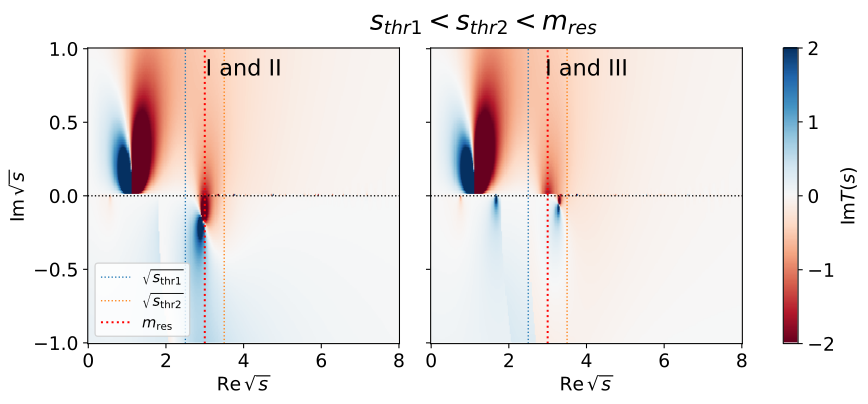
Depending on the centre-of-mass energy, different Riemann sheets connect smoothly to the physical one. Therefore, two cases are studied: one where the resonance mass is above the threshold of the second and first channel, and another where the resonance mass is between the threshold of the first and second channel. For the 2 channel one gets:
Visualize sheets#
2D#
Lineshape#
Caution
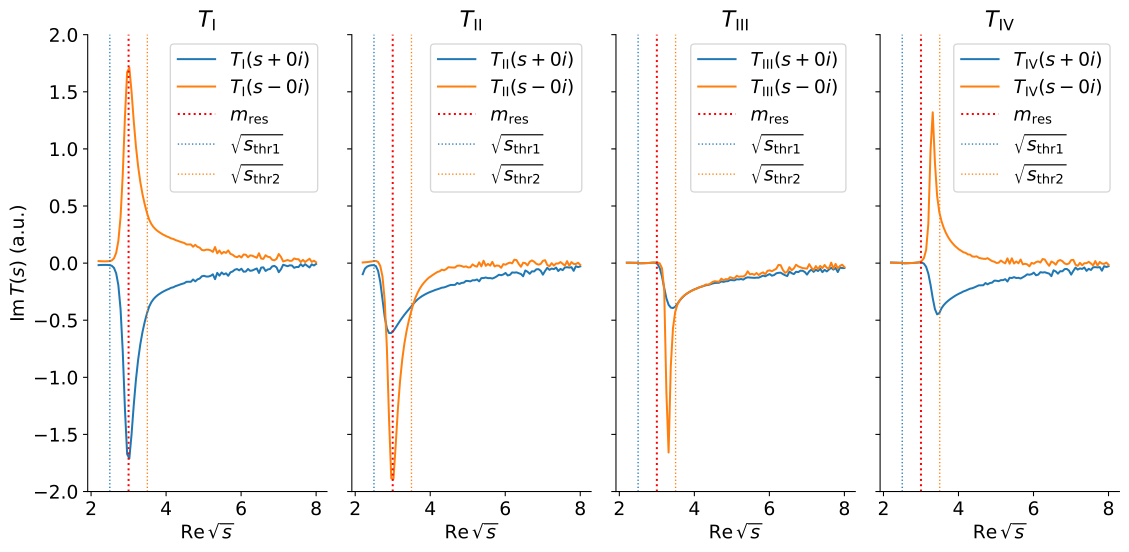
The integral does not appear to be numerically stable (see ComPWA/ampform#487), as a significant imaginary offset from the real axis (\(\epsilon = 10^{-2}i\)) is required to get rid of the instability fluctuations.
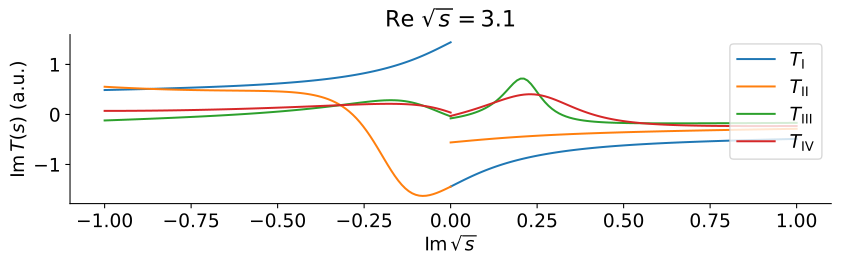
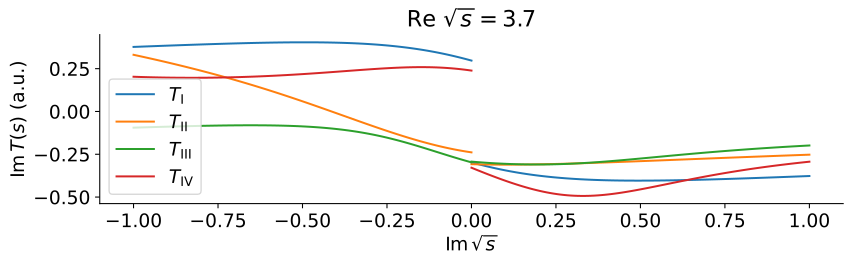
Connection (\(Im(T)\) v.s. \(Im(\sqrt{s})\) )#
Depending on the energy, a different unphysical Riemann sheet connects to the physical one. The structures on the connecting sheet have the most influence on the physical line shape.