





Dynamics#
By default, the dynamic terms in an amplitude model are set to \(1\) by the HelicityAmplitudeBuilder. The method assign() of the dynamics attribute can then be used to set dynamics lineshapes for specific resonances. The dynamics.builder module provides some tools to set standard lineshapes (see below), but it is also possible to set custom dynamics.
The standard lineshapes provided by AmpForm are illustrated below. For more info, have a look at the following pages:
Form factor#
AmpForm uses Blatt-Weisskopf functions \(B_L\) as barrier factors (also called form factors, see BlattWeisskopfSquared and TR-029):
from ampform.dynamics.form_factor import BlattWeisskopfSquared

L = sp.Symbol("L", integer=True, nonnegative=True)
z = sp.Symbol("z", nonnegative=True, real=True)
bl2 = BlattWeisskopfSquared(z, L)
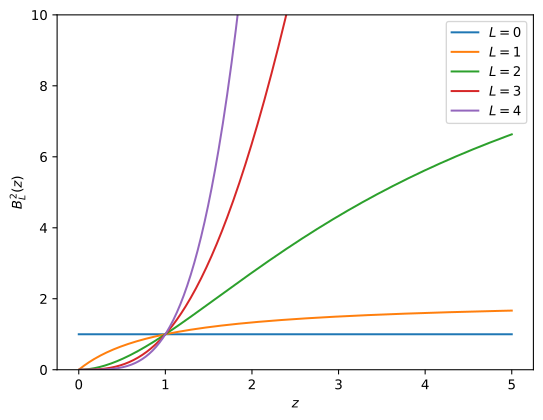
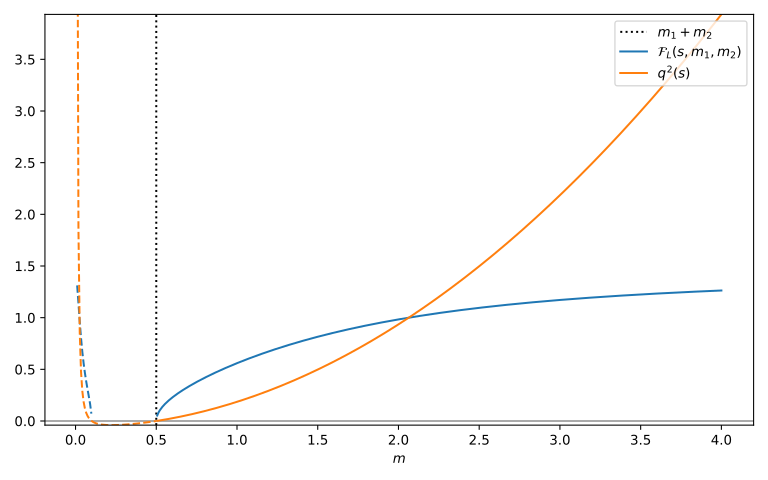
The Blatt-Weisskopf form factor is used to ‘dampen’ the breakup-momentum at threshold and when going to infinity. A usual choice for \(z\) is therefore \(z=q^2d^2\) with \(q^2\) the BreakupMomentumSquared and \(d\) the impact parameter (also called meson radius). The FormFactor expression class can be used for this:
from ampform.dynamics.form_factor import FormFactor

s, m1, m2, d = sp.symbols("s m1 m2 d", nonnegative=True)
ff2 = FormFactor(s, m1, m2, angular_momentum=L, meson_radius=d)
Relativistic Breit-Wigner#
AmpForm has two types of relativistic Breit-Wigner functions. Both are compared below ― for more info, see the links to the API.
Without form factor#
The ‘normal’ relativistic_breit_wigner() looks as follows:
from ampform.dynamics import relativistic_breit_wigner

m, m0, w0 = sp.symbols("m, m0, Gamma0", nonnegative=True)
rel_bw = relativistic_breit_wigner(s=m**2, mass0=m0, gamma0=w0)
rel_bw
With form factor#
The relativistic Breit-Wigner can be adapted slightly, so that its amplitude goes to zero at threshold (\(m_0 = m1 + m2\)) and that it becomes normalizable. This is done with form factors and can be obtained with the function relativistic_breit_wigner_with_ff():
from ampform.dynamics import PhaseSpaceFactorSWave, relativistic_breit_wigner_with_ff

rel_bw_with_ff = relativistic_breit_wigner_with_ff(
    s=s,
    mass0=m0,
    gamma0=w0,
    m_a=m1,
    m_b=m2,
    angular_momentum=L,
    meson_radius=1,
    phsp_factor=PhaseSpaceFactorSWave,
)
rel_bw_with_ff
Here, \(\Gamma(m)\) is the EnergyDependentWidth (also called running width or mass-dependent width), defined as:
from ampform.dynamics import EnergyDependentWidth

L = sp.Symbol("L", integer=True)
width = EnergyDependentWidth(
    s=s,
    mass0=m0,
    gamma0=w0,
    m_a=m1,
    m_b=m2,
    angular_momentum=L,
    meson_radius=1,
    phsp_factor=PhaseSpaceFactorSWave,
)
Math(aslatex({width: width.evaluate()}))
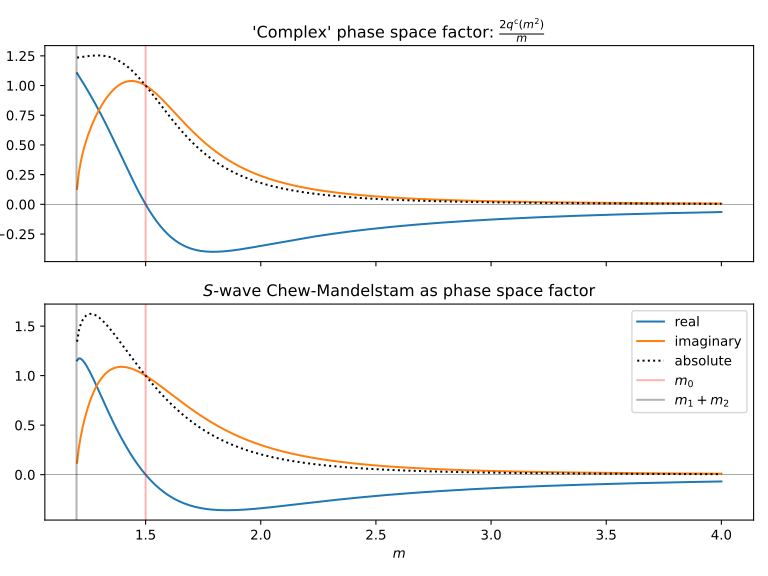
It is possible to choose different formulations for the phase space factor \(\rho\), see Analytic continuation.
Analytic continuation#
The following shows the effect of Analytic continuation a on relativistic Breit-Wigner: